

Last updated October 31, 2026
 House lockouts
 Re-keying
 Deadbolt upgrades
 Smart locks
 Schlage
 Kwikset
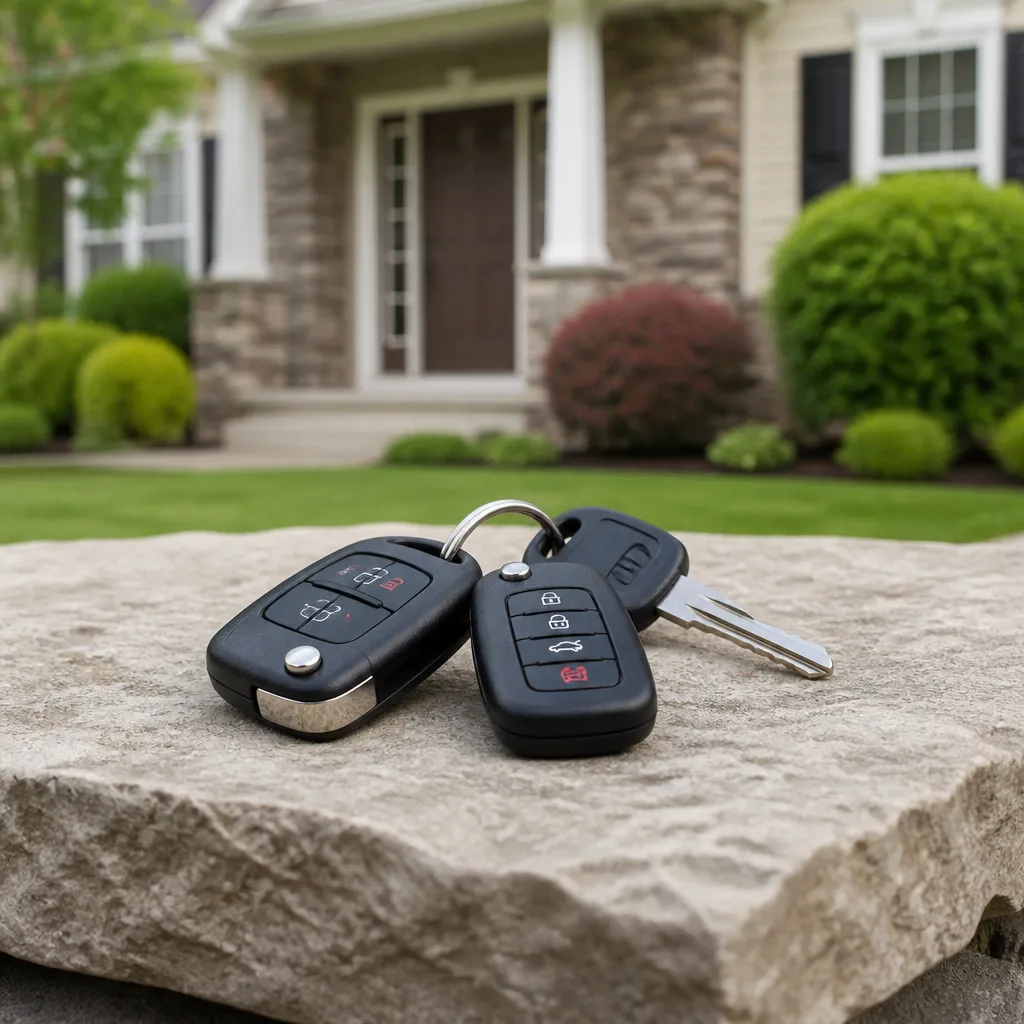 Car keys & fobs
Non-destructive entry first, always - and we re-key Schlage, Kwikset, and Baldwin locks on the spot while you watch
You get a price before we start. It does not change when we arrive. No surprises.
Get your free estimateCar Key Replacement Maintenance Checklist for Tacoma Homeowners
If you drive a car in Tacoma, you are probably one lost key away from a $400 dealership bill, and you won’t know it until you’re standing in a parking garage off Pacific Avenue at 9 p.m. with a dead fob in your hand. A replacement smart key for a 2021 Toyota Tacoma at a dealership typically runs $350 – $500 once programming is included, yet a qualified automotive locksmith in Tacoma will often do the same job for $150 – $220. This guide reframes car key replacement as the maintenance item it actually is: something you plan for, not something that happens to you. You’ll learn exactly when to replace fob batteries, when to cut a backup key, which Tacoma-area vehicles have the most expensive replacement processes, and how the salt air near Commencement Bay quietly destroys the electronics inside your key.
Quick Answer
A car key replacement maintenance checklist for Tacoma homeowners comes down to four recurring habits: test your spare mechanical key once a year, replace fob batteries every 18 – 24 months (sooner if you park near salt water), keep written documentation of your key code and VIN in a drawer at home, and know whether your vehicle falls into the high-cost replacement category before you ever need help. Spend twenty minutes a year on these four items and you will avoid the most expensive parts of automotive key replacement: emergency dispatch, dealership programming, and towing. For Car Key Replacement Troubleshooting: Common Problems and How to Fix Them, see our dedicated guide.
Styles & brands we work with
Table of Contents
- The Year-by-Year Maintenance Checklist
- Transponder Health: What It Is and When to Test It
- Fob Battery Replacement: The Cheapest Insurance You Own
- The Backup Key Strategy Every Tacoma Driver Should Have
- Which Tacoma-Area Vehicles Cost the Most to Replace
- Dealership vs. Locksmith: What You’ll Actually Pay in Tacoma
- Pacific Northwest Humidity, Salt Air, and Your Key Fob
- What to Have Ready Before You Call a Locksmith
The Year-by-Year Maintenance Checklist
Most drivers treat car keys as a binary condition: they either work or they don’t. But electronic keys fail gradually, and the warning signs are easy to miss until you’re pressing the unlock button eight times from across a wet Fred Meyer parking lot, hoping the car chirps back. A yearly checklist catches those failures while they’re still cheap to fix. Here is the schedule we recommend for every Tacoma household with at least one car.
- Every January: Test your spare key. If it’s a mechanical key, insert it into the driver’s door lock and the ignition (if your vehicle still uses a keyed ignition). Turn it. If it sticks, binds, or refuses to turn, the cylinder may be wearing down. A key cut from a worn original gets progressively worse each year.
- Every January: Write down your vehicle’s VIN, year, make, and model, plus the key code if you have it. Store this in a paper file at home, not in the glovebox, and not only as a note on your phone. Phones get lost. Gloveboxes lock.
- Every 18 – 24 months: Replace the battery in every remote fob and smart key you own, whether it seems weak or not. More frequent if you live within a mile of the water in Ruston, Browns Point, or Dash Point.
- Every 2 years: Have a locksmith cut and program one additional duplicate key or fob, then rotate it into service as your daily key and retire the previous daily key to your home drawer as the spare. This rotation prevents any single key from wearing to the point of failure while ensuring your spare is always the newest key you own.
- Every 3 – 4 years: Inspect the physical key blade for bending, chipping, or visible brass wear. On vehicles with push-button start, remove the hidden emergency key from the fob and test it in the door lock. Door locks that sit unused for years can seize, and the first time you discover this should not be during a dead-fob emergency in a Tacoma rainstorm.
None of these steps require special tools or more than a few minutes. What they require is the recognition that a car key is a wearable component, like brake pads or a serpentine belt, and that replacing it on a schedule is always cheaper than replacing it in a crisis. The key element here is rotation. Tacoma drivers who rotate a programmed spare into the daily slot every two years almost never experience a total no-start situation from key failure, because they always have a known-good key in reserve.
Transponder Health: What It Is and When to Test It
Since the late 1990s, virtually every vehicle sold in the United States has included a transponder chip inside the key or fob. That chip is a tiny RFID device that communicates with the vehicle’s immobilizer system. If the chip fails, the engine will crank but not start. The steering wheel won’t turn. The door locks will work fine because the mechanical blade is fine, but the car will not move. This is a common failure pattern in older vehicles where the transponder electronics degrade before the mechanical parts do, and it is one of the least understood car-key problems among Tacoma drivers.
Test your transponder’s function twice a year. The simplest method: start your vehicle with each key you own, not just your daily key. If one key starts the car and another does not, the non-starting key’s transponder has either failed or never been programmed. A key that works the door but not the ignition needs programming, and in some cases, it may be cheaper to cut and program a fresh key than to repair an old one that is slowly losing its ability to communicate with the car.
There is a second test worth running specifically for older vehicles in the Tacoma area. On a cold, damp morning, insert your key and turn it to the “On” position without cranking. If the security light on the dashboard stays illuminated for more than a few seconds, the car is struggling to read the chip. Moisture intrusion into the ignition cylinder is a known issue in this climate, especially for vehicles regularly parked outdoors in neighborhoods like Proctor or the Stadium District where covered parking is scarce. A transponder that reads intermittently today will eventually refuse to read at all, usually at the worst possible time.
If you discover a failing transponder before it dies completely, the repair path is straightforward: a locksmith can clone or program a replacement chip without towing the car anywhere. The work happens wherever the car is parked. If you wait until the car won’t start, you may also need a tow to a shop or dealer, which in Tacoma’s hillier neighborhoods adds $100 – $200 to the total bill depending on how far the tow goes. Testing is free. Towing is not.
Fob Battery Replacement: The Cheapest Insurance You Own
A fob battery costs about $3 to $6 over the counter and takes ninety seconds to swap with a small flathead screwdriver and a thumbnail. Yet thousands of Tacoma drivers dispose of perfectly functional fobs each year because they assume a dead fob means a dead key. It does not. The battery powers the remote functions: lock, unlock, trunk release, remote start. The transponder chip inside the fob is passive, powered inductively by the vehicle’s reader coil, which means a fob with a dead battery will still start the car when held against the ignition or start button, or when inserted into the backup slot. Knowing this distinction saves you an unnecessary emergency call.
Replace fob batteries on a calendar schedule, not when the fob starts acting up. Symptoms of a dying battery include: decreased remote range (you have to be closer to the car than you used to be), inconsistent response (sometimes it locks on the first press, sometimes the third), and a dashboard warning light indicating “key not detected” when the fob is in your pocket. By the time you notice any of these, the battery is days from full failure.
Where Tacoma makes this more urgent: coastal moisture. Fobs used by drivers who live or work near the Thea Foss Waterway, the Port of Tacoma, or any of the condos and apartments along Schuster Parkway are exposed to more salt-laden air than fobs used ten miles inland. That humidity accelerates battery terminal corrosion inside the fob, which can cause intermittent connection issues that look exactly like a failing button or a bad circuit board. A fob that has been through three or four years of waterfront parking often has green corrosion on the battery contacts when opened. Cleaning those contacts with a cotton swab and isopropyl alcohol occasionally restores full function; replacing the fob costs $150 – $300 depending on the vehicle.
The Backup Key Strategy Every Tacoma Driver Should Have
Most people are handed two keys when they buy a car, and within five years they can find one of them. The second key is in a jacket pocket, a moving box, a desk drawer at a former job, or it was lost entirely. This is the single biggest driver of emergency locksmith calls we see in Tacoma. A car key replacement is always more expensive when you have no working key at all, because the locksmith must originate a new key from scratch rather than duplicating an existing one.
Here is the strategy that costs the least over a ten-year period of car ownership:
- Own at least three keys per vehicle. One daily key, one spare key kept at home in a known location, and one emergency key kept with a trusted family member or in a safe deposit box. Three keys ensures that losing one never leaves you in a one-key situation.
- Make the spare key a mechanical backup, not an expensive fob. A basic transponder key with no remote functions typically costs $80 – $150 to cut and program for most vehicles, compared to $150 – $350 for a full smart fob. That mechanical backup will start the car and unlock the door, and it’s cheap enough to replace if it’s ever lost.
- Rotate the keys. Use the spare key for a full day once a month. This verifies the key works, prevents the door lock from seizing, and catches programming failures while they’re still trivial to fix.
- Never keep your only spare key in the car. This is the security equivalent of taping your house key to the front door frame. A thief who breaks into your car and finds a working key has your entire vehicle.
Cutting a backup key before you need it is one of the few automotive expenses that gets cheaper the earlier you do it. A key duplicated from a working original is simple labor. A key originated from nothing, with no key code on file and no working key to copy, requires disassembly, specialized programming, and sometimes a trip to a dealer. The price difference can be $200 or more on modern vehicles. In Tacoma, where vehicle theft remains elevated in certain ZIP codes and where a stolen car often means a stolen key anyway, a documented spare is the difference between a ninety-minute inconvenience and a five-day ordeal.
Which Tacoma-Area Vehicles Cost the Most to Replace
Not all car key replacements are priced the same. The differences come down to the vehicle’s security architecture: high-theft models using encrypted transponder systems, older vehicles with column-mounted ignition cylinders that require disassembly to originate a key, and newer vehicles with push-button start that require dealer-level programming software. If you drive one of the vehicles below in the Tacoma metro, your replacement costs will sit at the top of the range, and your maintenance checklist matters more.
- Full-size GM trucks and SUVs from the 2000s and early 2010s – These vehicles frequently used encrypted transponders and Passlock systems, and many Tacoma drivers own them as work trucks. Originating a key when all keys are lost often requires removing the ignition cylinder, reading the wafer codes, and cutting a key by code. Plan on the higher end of any quote.
- Ford F-150s and Super Duty trucks from 2015 onward – Push-button ignition and high-security transponder encryption mean these keys are dealer-programmable in many cases. Some locksmiths have the proper equipment and some do not. Ask specifically before dispatching.
- Honda vehicles from 2007 to 2022 – Honda’s immobilizer systems are notoriously picky about aftermarket programming. Most replacements require a locksmith with Honda-specific programming tools, and key codes are not always recoverable from the VIN without dealer access.
- German vehicles: BMW, Mercedes-Benz, Audi, Volkswagen – These are the most expensive keys on the road, often $300 – $600 at a dealer and still $200 – $400 through an independent locksmith with the right tools. The keys are ordered by VIN from the manufacturer in some cases, adding days to the timeline.
- Toyota and Lexus vehicles from 2018 onward – Toyota’s smart key system is robust, but replacement fobs are expensive and programming typically requires a working key to add a new one. If you lose all keys, the job gets significantly more complex. Given how many Tacoma drivers own Tacomas, 4Runners, and RAV4s, this is the most common high-end replacement we see.
The takeaway is not that these vehicles should be avoided. It’s that drivers of these vehicles should be extra disciplined about the backup key strategy above. A $150 mechanical backup key is trivial when compared to a $400 dealer replacement on a German SUV. Knowing where your vehicle sits on this spectrum tells you how seriously to take the maintenance checklist.
Dealership vs. Locksmith: What You’ll Actually Pay in Tacoma
The cost gap between a Tacoma dealership and a qualified automotive locksmith is consistent across nearly every vehicle category, and it’s driven by labor structure, not by differences in key quality. Dealerships charge book-rate labor for key cutting and programming, and they source keys from the manufacturer at list price. Locksmiths buy aftermarket and OEM-compatible blanks at wholesale, and they typically charge a flat fee for programming that reflects the actual ten to thirty minutes of work involved. Here are typical ranges for the vehicles most commonly driven in the Tacoma metro:
| Vehicle | Dealership Range | Locksmith Range |
|---|---|---|
| Toyota Tacoma (2016 – 2023) smart key | $350 – $500 | $180 – $280 |
| Honda CR-V (2017 – 2022) fob | $300 – $450 | $160 – $250 |
| Ford F-150 (2015 – 2023) fob | $280 – $420 | $150 – $240 |
| Chevrolet Silverado (2007 – 2014) transponder | $220 – $350 | $120 – $200 |
| Subaru Outback (2018 – 2023) fob | $300 – $460 | $170 – $260 |
| Nissan Rogue (2014 – 2022) fob | $260 – $400 | $140 – $230 |
| BMW 3 Series (2015 – 2022) smart key | $400 – $650 | $250 – $400 |
| Toyota RAV4 (2019 – 2023) smart key | $330 – $480 | $160 – $260 |
These ranges reflect the Tacoma market specifically. Prices at dealerships on South Tacoma Way and in the Auto Row area tend to run at or above the midpoint, while mobile locksmiths servicing the city typically quote at the lower end of the locksmith range for common Japanese and domestic vehicles. The delta is not a discount for lower quality; it’s the removal of dealership overhead and the manufacturer’s OEM key markup. The key blank itself is frequently identical.
One caution worth stating plainly: some locksmiths advertise a low base price and then add trip charges, programming fees, and “emergency” surcharges on site. A reputable Tacoma locksmith will quote the full price on the phone before dispatching anyone. At Lodestar Locksmith, the price quoted before dispatch is the price on the invoice, with no call-out surcharge tacked on at the door. If a phone quote feels vague, ask directly: “Is that the total price out the door?” If the answer is anything other than yes, call someone else.
Pacific Northwest Humidity, Salt Air, and Your Key Fob
Tacoma’s maritime climate is hard on car keys in ways that don’t show up in generic car maintenance advice written for drivers in Phoenix or Denver. Two factors matter here. First, persistent high humidity means moisture finds its way into fob housings, ignition cylinders, and door locks far more often than in dry climates. Second, salt air from Puget Sound carries chloride ions that accelerate corrosion on electrical contacts, particularly in neighborhoods close to the water: Ruston, Old Town, Browns Point, Dash Point, and anything within half a mile of the shoreline along Marine View Drive.
Corrosion inside a fob looks like a green or white crust on the battery contacts and on the circuit board traces. It causes the same symptoms as a weak battery, but replacing the battery only helps temporarily if the contacts themselves are corroded, the new battery won’t make reliable contact. The fix is usually straightforward: open the fob, clean the contacts with isopropyl alcohol and a cotton swab, and let it dry before reassembly. In our experience, this restores full function in roughly half of the Tacoma fobs that come to us with “dead battery” complaints.
Door lock cylinders and mechanical keys face a different problem. The locks on vehicles parked outdoors near the water collect moisture, and the brass or nickel-silver key blades corrode slowly. A key that sits in a drawer for three years may have a thin layer of tarnish that makes the lock bind. The cure for this is the same as for the fob: use it. Insert the spare key and cycle the door lock twice a year. It forces the cylinder pins to move, distributes any lubricant still present, and knocks off surface corrosion. A lock that works today because it’s used regularly will still work in five years. A lock that has been ignored since the car was purchased may not.
For drivers in Tacoma’s hilltop and inland neighborhoods like North End, Proctor, and McKinley, the humidity concern is less acute but not absent. Parking in a garage or under a carport makes a measurable difference in fob longevity. If you have covered parking, use it; if you don’t, the 18-month battery replacement schedule becomes a hard deadline rather than a suggestion.
What to Have Ready Before You Call a Locksmith
The difference between a one-visit car key replacement and a two-visit job often comes down to what you have in your hand when you make the phone call. Locksmiths need three pieces of information to cut and program a key correctly: proof of vehicle ownership, the vehicle’s identifying information, and the key code if available. Having these ready when you call means the technician arrives prepared and does the job in a single trip.
- Proof of ownership. The vehicle registration or title in your name, plus a government-issued photo ID that matches. Washington State law requires locksmiths to verify ownership before making keys for a vehicle. This is a consumer protection measure and a real one; no legitimate locksmith will skip it.
- Vehicle identification number (VIN). The VIN is visible through the lower-left corner of the windshield on most vehicles, and on the driver’s door jamb sticker. Write it down before you call. The VIN allows a locksmith to look up the correct key blank, the transponder type, and in some cases the factory key code.
- Year, make, and exact model – including trim level if you know it. A 2020 Honda CR-V EX has a different key than a 2020 CR-V LX on some model years. The wrong trim guess means the wrong blank, which means a second visit.
- The key code if you have it. The key code is a short alphanumeric string, usually stamped on a small metal tag that came with the original keys, or recorded in the owner’s manual packet. If you have this, the locksmith can cut a new key by code without extracting a cylinder, which is faster and cheaper.
- The location of the vehicle. Mobile locksmiths in Tacoma service the full metro, but drive time is part of the quote. Know the nearest cross streets, whether the vehicle is in a secured garage or open lot, and any access restrictions. These details affect both the schedule and the price.
Preparing these five items before you call turns a stressful situation into a routine one. It’s also the fastest way to get an accurate quote. When we answer the phone at Lodestar Locksmith, the first questions we ask are exactly these: ownership, VIN, model, key code, location. The sooner we get those answers, the sooner a technician is on the way.
Common Mistakes to Avoid
- Waiting until the only key is lost to think about key replacement. Every emergency replacement we handle in Tacoma is more expensive than the planned replacement that could have prevented it. A backup key cut today costs a fraction of an emergency originate-and-program tomorrow.
- Assuming a dead fob means a dead key. A fob with a dead battery will often still start the car when held against the start button or inserted in the backup slot. Try that before calling anyone, and then replace the $4 battery.
- Hiding a spare key somewhere on the vehicle exterior. Magnetic key boxes under the bumper and wheel well are the first places thieves check, and in Tacoma’s higher-theft corridors they check often. A car key hidden on the car is a stolen car waiting to happen.
- Calling a dealership first for a key replacement. Dealership quotes in Tacoma consistently run 60% to 100% higher than locksmith pricing for the same key, and the wait is usually longer. The exception: some European brands where independent programming is genuinely limited.
- Ignoring the mechanical backup key in a push-button fob. Most smart fobs contain a hidden emergency key that unlocks the driver’s door when the battery is dead. Tacoma drivers who have never pulled that key out to test the door lock discover during a dead-battery emergency that the lock has seized from disuse.
- Not documenting the key code. That little metal tag that came with the keys is worth $50 – $150 in saved labor when you eventually need a replacement. If you can find it, record the code somewhere permanent. If you can’t, a locksmith can often retrieve it, but it takes more time and more money.
- Accepting a vague phone quote. Any locksmith who won’t give a firm total on the phone is likely planning to add charges on-site. Get the full price, including trip fee and programming, before anyone is dispatched. If they won’t commit, call a different shop.
When to Call a Professional
Some car key situations are safe to handle yourself, like swapping a fob battery or cleaning mild corrosion off battery contacts. Others are not. If all keys are lost and you have no key code, a locksmith needs to originate a key, which involves key cutting, transponder programming, and sometimes cylinder removal. If a key has broken off in the ignition or door lock, extraction requires specialized tools and the wrong DIY attempt can push the broken piece deeper into the cylinder, turning a $120 extraction into a $400 cylinder replacement. If a push-button-start vehicle displays “key not detected” with a fresh battery in the fob, the issue is likely a failing transponder or receiver module; that’s a diagnostic job, not a battery job. For any of these scenarios, call a professional before making it worse. Lodestar Locksmith offers free estimates in Tacoma, handles car key replacement as a core service, and walks you through what to have ready on a Lodestar Locksmith home call at (855) 382-0943.
Frequently Asked Questions
Car key replacement in Tacoma typically costs $120 – $280 through a locksmith for most domestic and Japanese vehicles, and $300 – $650 at a dealership for the same vehicle. The final number depends on the year, make, and model, whether you have a working key to duplicate, and whether the key is a basic transponder or a smart fob. Call (855) 382-0943 for a firm quote before anyone is dispatched; the price we give on the phone is the price on the invoice.
Yes. A qualified automotive locksmith can originate a new car key from the vehicle’s VIN and key code, and if the key code is unavailable, the locksmith can read the wafer pattern directly from the ignition or door lock cylinder. This process takes longer than duplicating an existing key, but it is routinely done in Tacoma driveways and parking lots without towing the vehicle anywhere. Proof of ownership and a photo ID are required by Washington State law.
A locksmith is almost always cheaper than a dealership in Tacoma, typically by 40% to 60% for the same key and programming. The cost difference comes from dealership labor rates, OEM key markup, and scheduling overhead, not from any difference in key quality. Exceptions exist for certain late-model European vehicles where independent programming tools are limited, but for the vast majority of Toyotas, Hondas, Fords, Chevys, Nissans, and Subarus on Tacoma roads, the locksmith price is lower and the service is faster.
Most car key replacements in Tacoma are completed in 30 to 90 minutes on-site, depending on the vehicle’s security system and whether the technician is duplicating an existing key or originating a new one from scratch. Basic transponder keys are typically fastest, while push-button smart keys on newer vehicles require additional programming time. If the key code and proof of ownership are ready when the technician arrives, the job is almost always done in one visit.
No. Mobile locksmiths in Tacoma bring key cutting and programming equipment to wherever the vehicle is parked, whether that’s a driveway in North End, a parking garage downtown, or a lot off South Tacoma Way. Towing to a dealership is only necessary in rare cases where dealer-level programming is genuinely required, and even then, some mobile locksmiths with dealer-equivalent tools can complete the work on-site. Always ask before scheduling a tow.
Remove the fob from water exposure immediately, open the housing, remove the battery, and dry the interior and circuit board with a lint-free cloth. Do not apply heat, and do not attempt to recharge or use the fob until it is fully dry. If the fob was submerged in salt water, rinse the circuit board briefly with clean fresh water and isopropyl alcohol to remove salt residue before drying. If the fob fails after drying, a replacement is likely necessary; call a Tacoma automotive locksmith for a programmed replacement at (855) 382-0943.
The Bottom Line
Car key replacement in Tacoma does not have to be an emergency expense. The drivers who pay the least for car keys over the lifetime of a vehicle are the ones who treat key maintenance as a scheduled task: test the spare, rotate the keys, replace fob batteries on a calendar, document the key code and VIN, and know where their vehicle sits on the replacement cost spectrum. The drivers who pay the most are the ones who wait until the only key is gone and the car won’t start. Twenty minutes of maintenance per year is the difference. If you’re ready to build a spare-key strategy or need a replacement today in Tacoma, Lodestar Locksmith handles car key replacement as a core service, alongside Car Key Replacement in Lynnwood, Emergency Locksmith in Lynnwood, and Rekey Locks in Lynnwood for customers across the Puget Sound region.
Written by the team at Lodestar Locksmith, serving Tacoma since 2012. Explore more guides & resources on our blog.