
Last updated October 31, 2026
 House lockouts
 Re-keying
 Deadbolt upgrades
 Smart locks
 Schlage
 Kwikset
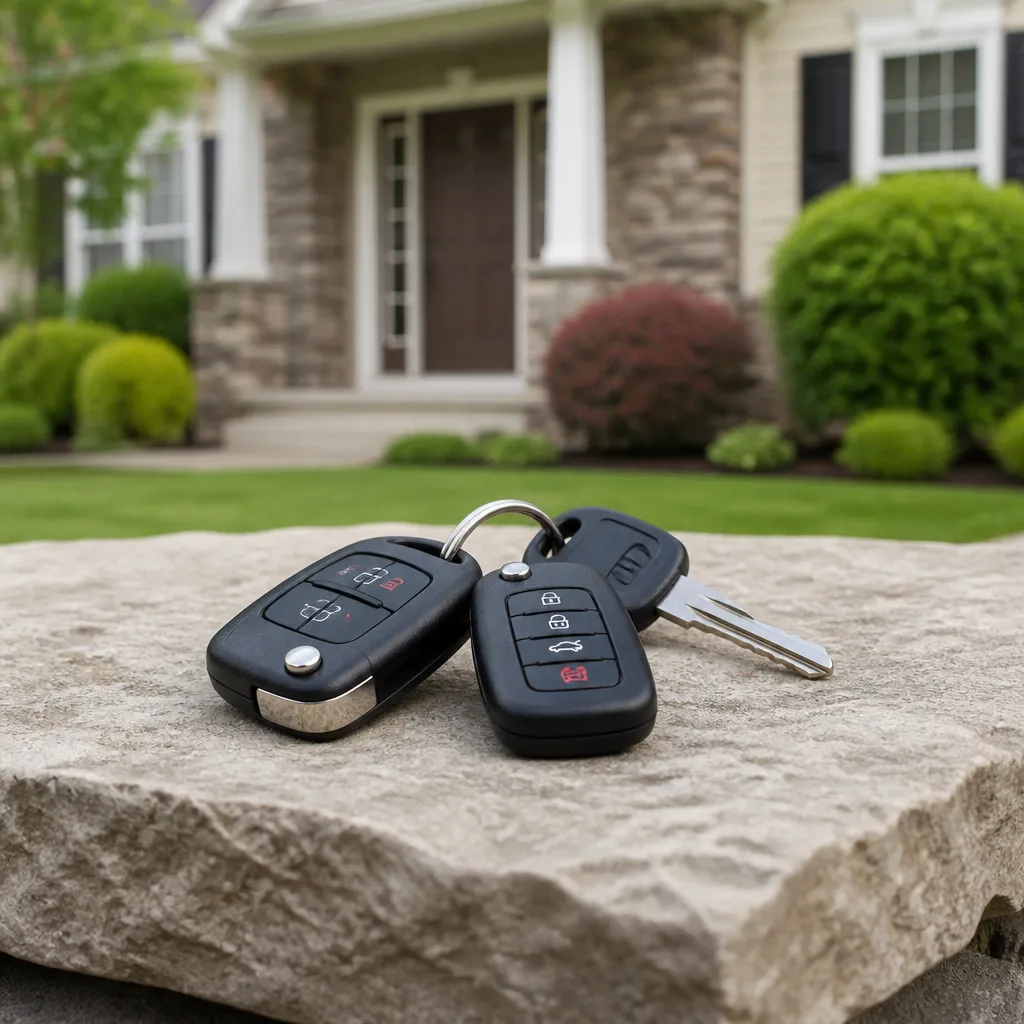 Car keys & fobs
Non-destructive entry first, always - and we re-key Schlage, Kwikset, and Baldwin locks on the spot while you watch
You get a price before we start. It does not change when we arrive. No surprises.
Get your free estimateThe Complete Car Key Replacement Guide for Tacoma Homeowners
A 2022 Toyota Tacoma owner who walks into a hardware store for a key copy will leave with a piece of metal that starts nothing. Every Tacoma built after 2010 requires transponder programming that a key-cutting machine alone cannot do, and that single fact changes everything about how car key replacement actually works in Tacoma. This guide maps the full decision tree: key type, vehicle year, whether the original still exists, and where to get the work done without wasting a day or several hundred dollars. By the end, you’ll know exactly which of six replacement paths applies to your vehicle and what to have ready before you make a single phone call.
Key Takeaways
- Car key replacement splits into at least six distinct procedures, and each has a different cost, timeline, and tooling requirement.
- Any Tacoma vehicle built after roughly 2007 will almost certainly need transponder or smart-key programming, not just cutting.
- Having the VIN and proof of ownership ready before calling changes the quote, sometimes by $50 or more.
- A mobile locksmith equipped for programming can usually finish the job on-site in under an hour; a dealership often takes days.
- The condition of your ignition cylinder matters as much as the key itself, especially in older trucks and SUVs common around Pierce County.
Lodestar Locksmith handles automotive key replacement alongside our full residential and commercial locksmith services, including rekeying and emergency response. This guide reflects what we see on Tacoma driveways and job sites every week, written so you can make one informed call instead of three frustrated ones.
Quick Answer
Car key replacement in Tacoma costs anywhere from $80 to $450+ depending on whether you have a basic metal key, a transponder key, a laser-cut high-security key, or a proximity smart fob. The fastest and usually cheapest correct path is calling a mobile automotive locksmith who can cut and program on-site; the slowest is a dealership, especially for vehicles over ten years old. Before you call anyone, have your VIN, proof of ownership, and any remaining working key in hand.
Styles & brands we work with
Table of Contents
- The Six Key Types You’re Actually Dealing With
- Why Tacoma’s Vehicle Mix Makes This Harder Than Average
- What to Have Ready Before You Call: VIN, Proof of Ownership, Working Key
- On-Site Locksmith vs. Dealership: Cost and Time Compared for Tacoma’s Three Most Common Vehicles
- How to Verify a Locksmith Can Actually Handle Your Key Type
- The Replacement Process, Step by Step
- The Ignition Cylinder Factor: What Goes Wrong in Older Tacoma Trucks
- Why Phone Quotes Vary by $100 or More
The Six Key Types You’re Actually Dealing With
Most people think a car key is a car key. We’ve had customers hand us a worn metal key from a 2004 Ford Ranger and a smart fob from a 2023 CR-V within the same week, expecting both to be handled the same way. They aren’t. Here’s the breakdown of what each key type actually involves.
1. Basic Metal Key (Pre-2000, Some Fleet Vehicles)
A plain steel key with no electronic chip. These exist mostly on vehicles from the 1990s and a few early-2000s base models. If your key has no thick plastic head and your vehicle predates 2000, this is likely what you have. Replacement is straightforward: a locksmith cuts the key from the original or from the lock codes, and it works immediately. Cost: $20 to $60. Time: 10 to 20 minutes.
2. Transponder Key (2000-2015, Most Makes)
This key looks like a standard key but has a small radio-frequency chip embedded in the plastic head. The chip sends a digital code to the vehicle’s immobilizer when you turn the ignition. No code, no start, even if the key turns. Transponder keys require both cutting and programming. Cost: $75 to $180. Time: 30 to 60 minutes, assuming the locksmith carries the right programming software for your make.
3. Laser-Cut / Side-Winder Key (High-Security Blanks)
Often called laser-cut or high-security keys, these have a thicker shank with a milled groove down the center rather than stamped edges. They’re harder to duplicate and require a specific cutting machine, not the standard duplicator at a hardware counter. Many Lexus, Honda, Toyota, and VW models use this style. Like transponders, laser-cut keys also carry a chip that needs programming. Cost: $120 to $220. Time: 45 to 75 minutes.
4. Proximity / Smart Fob (Push-to-Start)
This is the keyless fob that stays in your pocket while you press the start button. It broadcasts a rolling code that the vehicle recognizes within a few feet. When the fob battery dies, there’s usually a hidden physical key inside for door access, but starting requires the fob itself. Replacing a lost or damaged fob means buying the right OEM or aftermarket unit and programming it to your VIN. Cost: $180 to $350 for aftermarket; $300 to $500+ for OEM. Time: 45 to 90 minutes.
5. Remote Head Key / All-in-One Fob (Transition Era)
This is the combined key and remote unit where the key blade folds into the fob or sits in a fixed position with lock and unlock buttons. Common on GM, Ford, and Chrysler vehicles from 2005 to 2015. It combines the cutting of a transponder with the programming of both the chip and the remote functions. Cost: $150 to $300. Time: 45 to 60 minutes.
6. Worn or Damaged Key (Any Type)
A key that has been dropped, bent, or worn down from years of ignition turns can fail to turn the cylinder even if the chip still works. Sometimes the fix is replacing the key; sometimes the cylinder itself is the problem. This is the scenario that surprises people most because the key didn’t “break” in any dramatic way, it just stopped working one morning.
Each of these key types puts you on a different replacement path. Getting it wrong means paying for a cut that doesn’t start the car, then buying programming from someone else anyway. When you call a locksmith, the first question should determine which of these six situations you’re in.
We’re also familiar with the residential side of this picture, including Yale and Baldwin hardware, for customers who decide that while they’re having car keys replaced, a home rekey makes sense too.
Why Tacoma’s Vehicle Mix Makes This Harder Than Average
Tacoma drives trucks. That sounds obvious to anyone who’s sat in the northbound I-5 merge near the Tacoma Dome, but it has a specific consequence for key replacement. A city with heavy truck and SUV ownership, plus a working fleet economy, produces a higher proportion of vehicles that have been driven hard and turned off with dirty keys. What we see in Tacoma, particularly in neighborhoods like Proctor, Hilltop, and along the Port of Tacoma industrial corridor, is a pattern of worn ignition cylinders on vehicles with 120,000 miles or more.
That matters because a cylinder that’s been worn down by years of heavy keychains and repeated starts can reject even a correctly cut new key. The new key is made to factory specifications, but the cylinder has drifted. In those cases, a replacement key alone won’t fix the problem. The cylinder either needs reconditioning or replacement, which adds labor and cost. This is far more common on trucks and SUVs used for work, and Tacoma has a lot of those.
The second factor is the mix of old and new. Pierce County has plenty of late-model vehicles with push-to-start and laser-cut keys, but it also has a deep bench of 2005-2015 vehicles still in daily service: Tahoes, Silverados, Subarus, Camrys, CR-Vs. Those vehicles sit in the most complicated bracket because they need both cutting and programming, but their aging locks and ignitions introduce variables that a brand-new vehicle doesn’t have.
If you drive an older vehicle in Tacoma, the smart move is to replace a worn key before it fails entirely, and to have a locksmith who can also assess the cylinder at the same visit. This is the kind of situation where our emergency response work often starts with a car key problem and ends with us explaining why the lock itself is part of the issue.
What to Have Ready Before You Call: VIN, Proof of Ownership, Working Key
Three pieces of information change the price and the timeline of your car key replacement. Having them ready before calling saves a round of phone tag and gets the first quote accurate instead of ballpark.
- VIN (Vehicle Identification Number). The 17-digit number is on your insurance card, your registration, or visible through the windshield on the driver’s side dash. It tells the locksmith the exact year, make, model, trim level, and factory key type. Without it, a quote is a guess. With it, the locksmith can confirm which key blank and programming path applies before they dispatch.
- Proof of ownership. Any reputable locksmith, including us, will ask for a registration or title matching your ID before making a key. This is a security requirement, not a formality. A vehicle key is access to a $20,000 to $60,000 asset, and no legitimate operation cuts one without verifying ownership. Having the document ready speeds everything up. Some customers think this rule is only for dealerships; it applies to mobile locksmiths too.
- Whether any working key still exists. This is the single biggest price variable. If you have one working key, programming a new transponder or smart key usually costs less because the vehicle can be put into a learn mode using the existing key. If all keys are lost, the locksmith may need to erase the old key slots and reprogram from scratch, which takes longer and sometimes requires additional software steps. In some vehicles, “all keys lost” programming is the difference between a $90 job and a $220 job.
A fourth piece of information helps if you have it: whether the key has ever been replaced before, and if so, where. Some aftermarket keys are low-quality clones that don’t behave like the OEM chip, and a locksmith seeing one for the first time needs to know what they’re working with.
On-Site Locksmith vs. Dealership: Cost and Time Compared for Tacoma’s Three Most Common Vehicles
Here’s what we see on the ground, based on the vehicles we’re called about most often in Tacoma. These are honest ranges, not cherry-picked numbers.
Toyota Tacoma (2016-2023)
- Key type: laser-cut transponder or smart fob, depending on trim.
- Dealership cost: $250 to $500 for a transponder key and fob, plus a service appointment and often a multi-day wait if the key isn’t in stock.
- Mobile locksmith cost: $150 to $350, completed at your location in under 90 minutes.
- Tacoma-specific note: Toyota vehicles in this era sometimes store key info in a way that makes all-keys-lost programming take longer than average. The locksmith needs a current-generation programming tool, not an older universal unit. Ask about Toyota specifically on the phone.
Ford F-150 (2005-2020)
- Key type: transponder key or remote-head key, depending on year.
- Dealership cost: $200 to $420, with the same scheduling delays.
- Mobile locksmith cost: $100 to $280.
- Tacoma-specific note: These trucks are everywhere in Pierce County and many have high mileage. The ignition cylinder on an F-150 with 150,000 miles is a common failure point, and replacing the key won’t fix a cylinder that’s given out. A locksmith with automotive experience will check cylinder condition rather than just hand over a new key.
Honda CR-V (2007-2022)
- Key type: laser-cut transponder key with remote, or smart fob on newer models.
- Dealership cost: $180 to $380 for key and programming; often a one-week lead time for parts.
- Mobile locksmith cost: $120 to $300.
- Tacoma-specific note: Honda’s laser-cut keys are durable but the remote buttons wear out before the blade does. When the button fails, the key still turns but the remote stops. A locksmith can swap the remote shell and transfer the blade and chip, which is significantly cheaper than a full replacement. Dealerships rarely do this; they sell a full new key.
The consistent thread: a mobile locksmith doing programming on-site beats dealership pricing and timing in most scenarios, but only if they carry the correct software for your specific vehicle. Which brings us to the next section.
How to Verify a Locksmith Can Actually Handle Your Key Type
Before a locksmith dispatches to your Tacoma driveway, ask these specific questions. A competent operation answers them without hesitation. A mediocre one changes the subject.
- “Do you carry programming equipment for [your make and year]?” This is the only question that matters if your vehicle is post-2007. Some locksmiths cut keys but don’t program; others program but only for a narrow band of domestic vehicles. If the answer is “I can cut it and then you drive to the dealer for programming,” that’s not a solution. Keep calling.
- “What OBD-II tool do you use for my vehicle?” This question reveals technical range. A shop that can name a current-generation programmer, such as an Autel IM series, Smart Pro, or MVP Pro, and knows which one your make requires, is equipped. A shop that says “we use a machine” without specifying isn’t. You don’t need to know the tool yourself; you need to hear that they do.
- “Have you done an all-keys-lost on this vehicle before?” If you don’t have a working key, this matters. Some programming procedures require reading a security PIN from the vehicle’s immobilizer or a dealer code lookup. A locksmith who hasn’t done this on your make may take twice as long or may not be able to finish. The answer you want is a specific “yes, on a 2018 CR-V” type answer, not a vague “we do all vehicles.”
- “What’s your price if the job requires cylinder work?” A locksmith who immediately quotes the base key price without acknowledging that an older vehicle might need cylinder attention isn’t being straight with you. The conversation should include the possibility that the job expands. If they’re surprised when the cylinder is worn, they don’t do this work often enough.
For anyone who’s also thinking about home security while a locksmith is already headed over, we work in brands like Mul-T-Lock and Sargent, which is a separate conversation but the same core question: does the person with the tools actually know what’s in front of them?
On the residential side, the equivalent question is whether the locksmith can rekey locks in Lynnwood or Tacoma across multiple brands, not just swap in a Kwikset cylinder and call it a day.
The Replacement Process, Step by Step
Here’s what a proper car key replacement visit should look like, from first call to finished key. This applies whether the locksmith comes to your home in Tacoma’s North End, a parking lot in the Proctor District, or your office near the Tacoma Mall.
- Phone intake. You provide the year, make, model, VIN, and whether a working key exists. The locksmith confirms the key type, quotes a firm price range, and tells you exactly what programming tools they’ll bring.
- Ownership verification. When the locksmith arrives, they check your registration or title and your ID before starting. This is a non-negotiable security step and a sign of a legitimate operation.
- Key cutting. If a mechanical key exists to duplicate, the locksmith cuts the new blank from the original. If all keys are lost, the locksmith either cuts from the VIN-derived code or progresses the lock mechanically to determine the cuts, depending on the vehicle.
- Programming. For transponder, laser-cut, or smart keys, the locksmith connects a programmer to the vehicle’s OBD-II port, which on most cars sits under the dashboard on the driver’s side. The tool reads the existing immobilizer data, adds the new key’s code, and verifies that it starts the vehicle.
- All-keys-lost procedure (if applicable). When no working key exists, the locksmith erases the vehicle’s stored key list and starts fresh. This takes longer and explains the higher price.
- Testing and cleanup. The new key is inserted and turned, the engine is started, and the locksmith confirms remote buttons work. The old key slots, if any, are confirmed as either still active or deleted, depending on what you requested.
- Payment and documentation. A proper locksmith provides a receipt showing what was cut, what was programmed, and the total price. No surprises added on site.
Each step should be explained as it happens. A locksmith who won’t walk you through this process is probably new, rushed, or hiding something.
The Ignition Cylinder Factor: What Goes Wrong in Older Tacoma Trucks
Let’s talk about the part of this that rarely shows up in generic car key guides. The ignition cylinder is the mechanical lock that your key slides into. In a vehicle with 100,000 miles or more, that cylinder has seen thousands of key insertions, often with heavy keychains pulling sideways on the lock. Over time, the internal wafers and springs wear down, and the cylinder starts to behave unpredictably: the key won’t turn on the first try, it sticks mid-rotation, or it turns but won’t engage the electrical switch.
In Tacoma, with our damp winters and heavy truck usage, this is more common than the national average. Moisture from Puyallup river fog and Puget Sound marine air accelerates internal corrosion in older cylinders, especially in work trucks parked outdoors year-round.
A new key cut to factory spec will not fix a worn cylinder. The cylinder has drifted, and the correct solution is either reconditioning the existing cylinder (new internal wafers matched to the new key) or replacing the cylinder entirely. A locksmith with automotive experience can tell you which path applies within a minute of inserting the old key. A dealership will often replace both the lock and key preemptively, because that’s the cleaner job under warranty constraints, but it’s also the more expensive one.
If you have an older Tacoma, F-150, or Silverado in the Pierce County area and the key has been getting harder to turn, have it looked at before it fails completely. The repair is cheaper before the cylinder seizes.
This is also where our emergency locksmith response becomes relevant. When the key stops turning at 9 PM in a Tacoma parking lot, that’s not a key replacement problem. That’s a cylinder and key problem that needs both services at once.
Why Phone Quotes Vary by $100 or More: The Cost Honesty Section
There’s a well-earned skepticism around locksmith pricing, and we’re going to address it directly because it affects how you choose a provider. When you call for a car key quote in Tacoma, you might hear numbers ranging from $80 to $400 for what sounds like the same job. The difference isn’t usually fraud. It’s a combination of four things.
- Key type and programming depth. A basic metal key costs $30 to cut. A laser-cut key with a chip that needs all-keys-lost programming costs $200+. If you describe your key vaguely over the phone, quotes will be vague too. Giving the VIN eliminates most of this spread.
- OEM vs. aftermarket parts. Some locksmiths quote OEM-only parts, which can double the fob cost. Others quote quality aftermarket parts that function identically for most vehicles. Ask which one they’re pricing. A transparent shop offers both and explains the tradeoff.
- Tool investment. This is the quiet factor. A locksmith who owns current-generation programming equipment and keeps updates paid for has higher overhead than a shop with a 2015-era cloner. That overhead shows up in the quote, but it also means the job gets done correctly the first time. The cheap quote might mean old tools, and old tools can’t handle a 2022 Tacoma.
- Call-out minimums. Many operations charge a service fee on top of labor. The honest version is a flat quote that includes everything: trip, labor, parts, programming. Ask directly: “Is the number you just gave me the final invoice price?” If the answer is anything other than yes, keep looking.
We quote the full price on the phone before anyone is dispatched, and that number is what appears on the invoice. No call-out surcharge added on arrival. If the cylinder turns out to need work, we discuss the expanded cost before touching it, not after.
Common Mistakes to Avoid
- Going to a hardware store for a post-2007 vehicle. The machine can cut the metal but it can’t program the chip. You’ll leave with a key that opens the door and starts nothing.
- Losing all keys and then calling the dealership as a first move. Dealerships can handle it, but the tow to the dealership, the service appointment, and the parts wait routinely add two days and $150 to $300 over the cost of a mobile locksmith doing the same job in your driveway.
- Hiding the all-keys-lost situation from the locksmith on the phone. Some people understate the problem hoping for a lower quote. All it does is send the wrong tools and waste a service trip. Be accurate.
- Ignoring a key that’s becoming hard to turn. In Tacoma’s damp climate, a stiff ignition cylinder is a warning sign, not a quirk. Addressing it before it fails saves a tow and an emergency call.
- Carrying a keychain with ten pounds of keys on the ignition key. This isn’t just a fashion choice; it’s a mechanical problem. Heavy keychains pull sideways on the cylinder and accelerate precisely the wear described above.
- Buying a $20 clone key from an online marketplace and expecting it to work like an OEM key. Clone keys for transponder vehicles often interfere with subsequent programming and sometimes fail after a few months. A qualified locksmith can tell you whether the key you have is a clone and whether that’s complicating your situation.
When to Call a Professional
Some car key situations are worth attempting yourself. A simple metal key for a 1998 Camry? A hardware store copy works. But if your vehicle has a transponder, laser-cut key, proximity fob, or push-to-start system, DIY options don’t exist in any reliable form. The programming requires diagnostic equipment and vehicle-specific software. Similarly, if your key turns but the ignition doesn’t engage, or the key is bent but still works, don’t wait. The failure is coming, and it rarely comes at a convenient moment.
Lodestar Locksmith offers free estimates in Tacoma. Call (855) 382-0943 and describe your vehicle honestly. We’ll tell you the key type, the price, and whether the cylinder needs attention, before a truck rolls.
Frequently Asked Questions
A basic metal key replacement in Tacoma typically runs $20 to $60. A transponder key runs $75 to $180. A laser-cut key runs $120 to $220. A smart or proximity fob runs $180 to $500 depending on whether you choose aftermarket or OEM. The final price is set by your VIN, whether a working key exists, and whether the ignition cylinder needs attention. Call (855) 382-0943 for a free phone estimate based on your specific vehicle.
Yes. The price Lodestar Locksmith quotes on the phone is the price on the invoice. The only exception is if the ignition cylinder or lock itself needs work beyond the key, and in that case we discuss the expanded scope and cost with you before doing anything.
Emergency response is a core service, not a premium add-on. Call (855) 382-0943 and describe the situation, including the vehicle’s year, make, model, and whether any keys remain. We’ll give you an honest arrival window and the full price before dispatch.
No. Push-to-start vehicles can be serviced by a mobile locksmith who carries current-generation programming equipment and the correct fob. The cost is typically 30 to 50 percent lower than dealership pricing, and the work is done at your location. Ask the locksmith directly whether they program push-to-start for your make and year.
Yes. Lodestar Locksmith works across automotive, residential, and commercial security, including rekeying services and high-security brands like Mul-T-Lock and Sargent. One call covers the lock, the key, and the car.
A key that sticks or requires jiggling is usually a sign of a wearing ignition cylinder, especially in trucks and SUVs with high mileage in Tacoma’s damp climate. The fix may involve reconditioning the cylinder rather than replacing the key. Call (855) 382-0943 and describe what you’re feeling; we’ll tell you whether a simple key replacement will solve it or whether the cylinder needs attention too.
The Bottom Line
Car key replacement in Tacoma is a decision tree, not a single service call. The path you’re on depends on the key type, the vehicle’s year, whether a working key survives, and the condition of the ignition cylinder. A hardware store works for almost nothing built after 2007. A dealership works but costs more and takes longer. A mobile locksmith with current programming equipment and honest phone pricing sits in the middle and usually finishes the job in under an hour at your location. Have the VIN, proof of ownership, and an accurate description of the problem ready, ask the right questions, and you’ll pay for the correct fix the first time. For Tacoma car key work, call Lodestar Locksmith at (855) 382-0943 for a free estimate and a straight answer about what your vehicle actually needs.
Written by the team at Lodestar Locksmith, serving Tacoma since 2012.